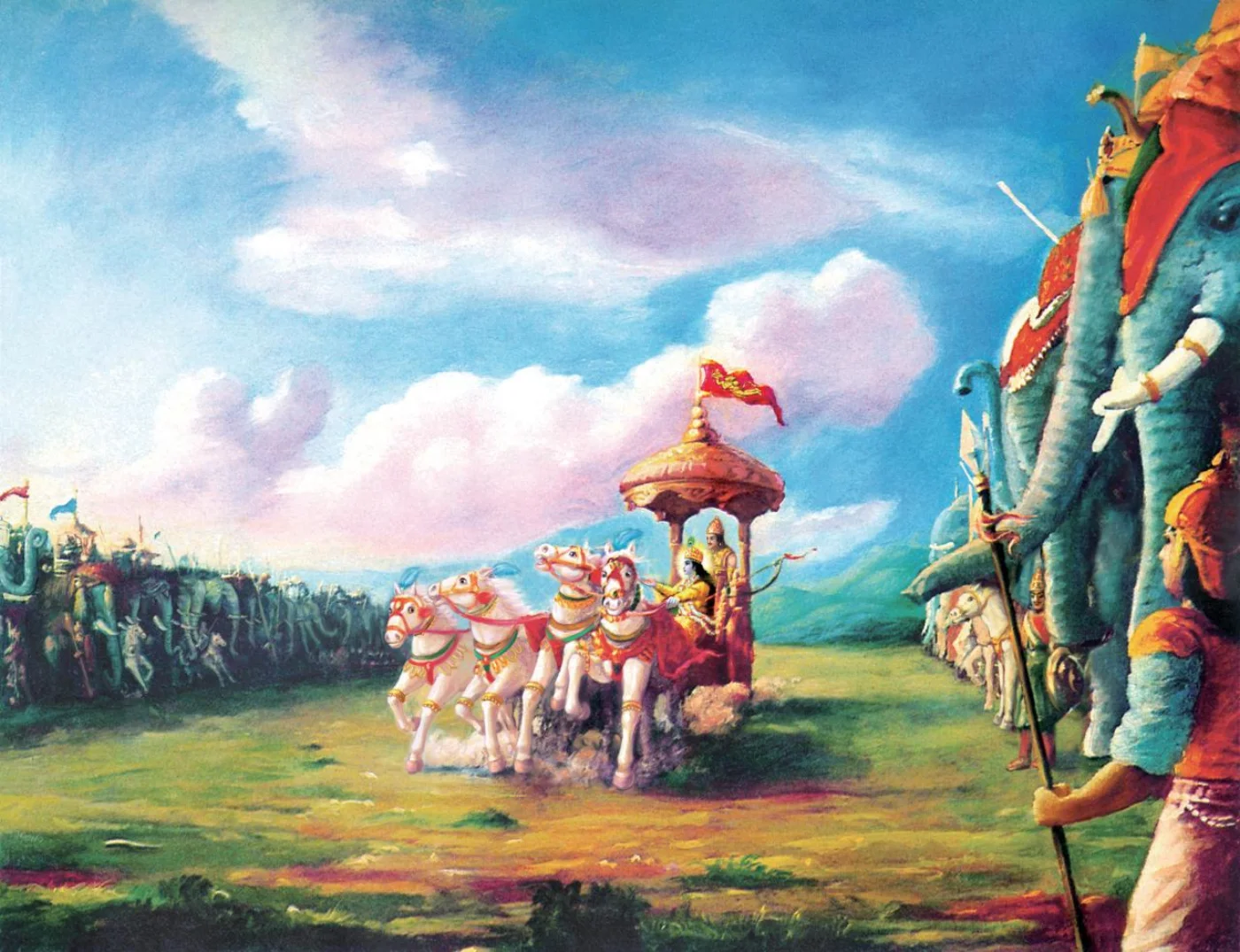
As part of my work writing my book, I had to dig deep into examples of dharma in the Mahabharata. There are some big, obvious cases of dharma and the conflicts around it in the story: Arjuna on the battlefield speaking to Krishna in the Bhagavad Gita. And Yudhishthira having to tell a half-truth in order to trick Drona into stopping fighting is another. These are big scenes, but there are other interesting cases around dharma, and I want to discuss a few of them.
1. Bhima and the Demon Baka
The Pandavas are in hiding after narrowly escaping an assassination attempt in the House of Lac. While staying with a Brahmin family in a small village, they are keeping hidden to prevent their cousins from discovering that they survived the fire. The village has a problem: a demon named Bakasura who demands regular tribute. Food, delivered by a human who gets eaten along with it. (Note the mythological parallel with the Greek story of Athenians sacrificed to King Minos’s Minotaur.)
When it comes to this family’s turn, Bhima volunteers to go in their place. He kills the demon. Village saved.
The heroism is obvious. The dilemma is subtler. The Pandavas were supposed to stay hidden. Killing a demon is not a low-profile act, especially when you’re the size of Bhima. He risks blowing their cover and putting all five brothers in danger. So where does his duty actually lie — to the strangers suffering in front of him, or to the family depending on him staying invisible?
2. Kunti’s Secret
Before she was the mother of the Pandavas, Kunti used a divine boon to conceive a child. His name was Karna. Afraid of the scandal — she was unmarried — she put the infant in a basket and set him adrift on a river. (Moses, anyone?) He was raised by a charioteer’s family, far from royalty, and spent his life being dismissed as low-born.
Years later, with war imminent, Kunti finally tells Karna the truth. He’s the eldest Pandava brother. She begs him to switch sides.
He refuses. His loyalty is to Duryodhana, the one person who gave him respect and standing when the rest of the world didn’t. That loyalty is his dharma, and he won’t break it.
What haunts me about this story is Kunti’s silence. Decades of it. Was she protecting herself? Protecting him? Was the abandonment the violation, or was it the only choice available to her?
3. Bhishma’s Loyalty to the Throne
Bhishma is one of the epic’s great figures — a man who gave up the throne and renounced marriage entirely, binding himself to the service of the kingdom. His sense of duty is almost impossible to comprehend by modern standards.
It’s also what destroys him.
When Duryodhana starts making clearly unjust decisions, Bhishma doesn’t stop him. He serves the throne. He can see exactly where this is heading. He knows Duryodhana is wrong. And still he stays loyal to the institution rather than his own judgment.
It’s uncomfortable, because we can watch the catastrophe approaching in slow motion, just like Bhishma. The question the epic is really asking is whether there’s a point where loyalty to a system becomes its own kind of moral failure.
4. Draupadi’s Question
The dice game is one of the most disturbing scenes in the whole epic. Yudhishthira gambles away his kingdom, his brothers, and finally Draupadi herself.
When she’s dragged into the royal court, she doesn’t beg. Instead she asks a question. A legal one. If Yudhishthira had already lost himself before he wagered her, did he actually have the right to wager her at all?
The court goes silent. Everyone in that room knows she’s right. But no one answers. The elders — men who are supposed to know the law, who know dharma — can’t agree on what to do when power, law, and ethics collide in a way no one has rules for.
Her question is never cleanly answered.
5. Karna’s Final Choice
This might be my favorite dharma moment in the entire epic.
The god Indra comes to Karna in disguise and asks for his divine armor and earrings. The gifts from his father, the sun, make Karna nearly invincible in battle. Karna sees through the disguise immediately. He knows what giving this away will cost him. He knows the war is coming.
He gives it away anyway.
Because generosity is who Karna is. His personal dharma is to never turn away someone who asks, even when the request is manipulative, even when it benefits his enemies. He chooses principle over survival. And the epic treats this as nobility.
That’s the hard thing about dharma in the Mahabharata. There’s no cheat sheet. The right action keeps depending on who you are, what you value, who you’re responsible to, and what you’re willing to lose for it.
What strikes me about all five of these stories is that the Mahabharata doesn’t judge any of them. Bhima acts. Kunti stays silent. Bhishma follows the wrong king. Draupadi asks the question nobody will answer. Karna gives away the thing that will get him killed. The epic just watches. That’s the part that stays with me: the sense that dharma isn’t a code you can memorize and apply. It’s something you keep having to discover, usually in the moment you least want to.